Stumbling into Oporto
 

Caught up in the free generosity of the couch surfers, I arranged to stay with another one in Porto – Juan, who happened to mention a little too late that he actually didn’t have enough room but I could share his mattress (because that’s a normal thing to offer to a stranger). But I am too tired to care and can’t be bothered with finding another place right now. Juan meets me at the bus station. His English is horrendous and the only phrase he seems to have down is “more or less” which he says every other word, about everything. He is an Erasmus (student) from Spain studying here and living in an old abandoned type mansion reminiscent of an old boarding school that hasn’t been touched in centuries, with 30 other twenty-something-year-old Erasmus. None of which seem to be doing any studying at all; they have not learned Portuguese, or anything for that matter. 

Luckily for me, and most unfortunately for her, a German couch surfer named Simone has arrived a few hours before me and has already won Juan’s affections and mattress, so I get smuggled into an old unoccupied room. There is a piece of foam on the floor for a bed, anarchy graffiti on the dresser and the walls look like they’ve been slaughtered with a machine gun. The place is filthy. I find some blankets in an old wardrobe that are probably infested with God knows what but I sleep with them anyway. I will most likely be contracting some Portuguese disease here, but again, I am too tired to care. It is an experience if nothing else.


When I wake up from my nap to leave the room, I turn the handle and the doorknob falls off. I’m trapped in the room. I look out the window and think about climbing out but I’m on the third floor. Someone has strung together three children's babydolls by their shoelaces and slung them up over the phone line in the courtyard, so they just hang there like abandoned terrifying chucky dolls right outside my window. I decide to either remain trapped in my room or wait for Juan and Simone, who thankfully decide to come see what I’m doing an hour later.

Juan, this kid, literally offers us food in the Erasmus kitchen which looks like a 1917 war camp mess hall and is completely covered with dirty pots and pans and open food that looks like it hasn’t been touched or cleaned in decades. I am starving but settle for a few spoonfuls of Nutella, the only unopened, seemingly untouched thing available. He takes us to a local bar and I am surprised at how well the Portuguese speak English. I am reminded over and over again that Portugal is indeed a country and they are nothing like and in no way affiliated with Spain (they have an adamant resentment towards the Spanish.) Their impeccable language diversity, they say, comes from growing up with televisions that do not translate any shows or movies into Portuguese, but instead provide you with subtitles. All of them seem to be in Vetinarian school and they are positively overjoyed when I tell them that we do, in fact, learn in American schools that Christopher Columbus was Portuguese and not Spanish. 

I leave early because I am exhausted and once back in my room, which now has no lock or door handle, I push a bookshelf against the door in attempts to keep me “safely” in this dilapidated place, and sleep until 2 pm. I am awoken by the sound of the bookshelf moving across the floor (my nightmare) as Juan pushes his way in to wake me up. Waking up now is always a disorienting experience, trying to remember where I am. A Spanish panda on a tent floor one night and a smuggled fugitive in an abandoned mansion on a Portugal floor the next.

I shower in a bathroom that leaves you feeling dirtier than when you walked in and rummage through my back pack to try to find clean clothes. I am out of underwear and all my white shirts are brown. My clothes smell and my efforts are way past my hair so it stays in a curly disarray of frizz. I now feel more comfortable being hideous than I ever have in my life. The uglier the better to ward off the Spanish men, who are by far the most relentless and exhausting I have ever come across.

Speaking of relentless, Juan is now pouting after being repeatedly declined by Simone all night long, so she and I make our way out in Porto alone to explore the city. Every street is so steep here! Nothing is flat; you are either panting while crawling straight up hill or trying not to topple over sprinting straight down. If you get stuck on a downward slope when you meant to be going up, good luck to you. This happens to us several times trying to find a way to get over the bridge to the other side of the river. We can see the bridge from almost every turn but we end up going too far up and then way too far down to the bottom of the river until we finally find it.


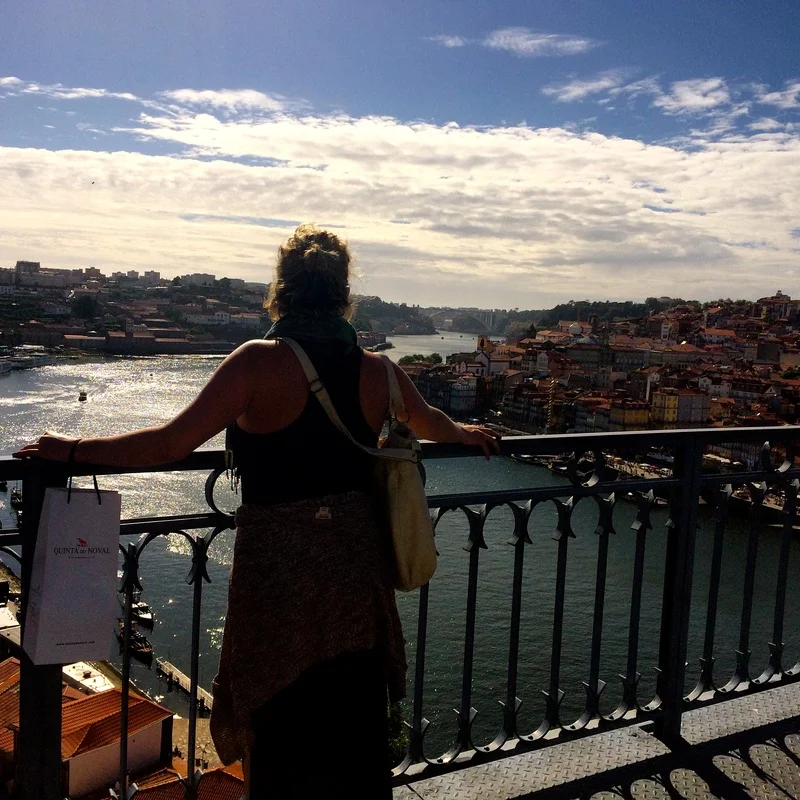
Porto is absolutely breath taking from atop this bridge, miles and miles above the sea. It is, indefinitely, the most beautiful place I have come across thus far. The river sparkles like a thousand tiny diamonds and each of the city’s buildings in brightly colored luminosity are visible on either side of the hilly landscape. People scatter below on each side of the river at outdoor cafes, or lounging along the riverside. Across the bridge, Gallo, is covered in Port Houses, some being the oldest in the world.

After walking in and then back out of Port Houses where bottles went for 592 euros, Simone and I settle at a small table at Quinta do Noval on the side of the river. Quinta do Noval is one of the oldest historical Port vineyards and they are very proud of their majestic terroir. The wall beside us reads: "The consistency of style of the Vintage Ports of Quinta do Noval through the decades is one of the particularities of Quinta do Noval in the world of Port. Consistency quite simply because our Vintage Ports come from one single vineyard, a specific and magical place. When you come to know Quinta do Noval, its old and its young Vintages, you will be able to recognize its future Vintages.” I found that quite interesting ... being able to recognize future vintages. 

We tasted through at least 7 mini bottles of Noval's ports: Fine White, Lagrima, Ruby, Tawny, Tawny Reserve. Of course, limited by our funds to the lower end of the menu offered. Each was so different and exquisitely unique. The man pouring them for us told me that Ruby was the younger sibling of Tawny with more fruit flavors and excitement but hardly as delicately wise or refined as the older Tawny. The Fine White was surprisingly delicious and became our favorite. I had never had a white port but it was full of citrus and honey flavors, perfect for the heat of the day.

Simone tells me all about German culture, and Brazilian, and Spanish - all places that she has lived. She speaks four languages and is a language teacher in Germany, which makes her a slave of the country. Technically, she cannot even jay-walk without getting in trouble because she is meant to be a model citizen, bought and paid for her examplary behavior. It's so fascinating to hear about how other people live and I've learned almost as much about cultures and places I have yet to visit than Spain itself. 

We go for a very long, very expensive dinner back on our side of the river that night and then meet Juan to drink the bottle of Quinta do Noval Fine White Port we had bought by the water. You can see all of the Port houses across the river in the darkness. Their names are the only signs lit up and scattered sporatically amongst the rocky hill. 

That night I don't sleep at all. More sober than the night prior, I toss and turn with torturous thoughts of what kind and how many people have used these stained pillows before (which have no pillowcases) and what this piece of foam might be infested with. I feel things crawling on me all night although I am sure they aren't really. The next morning, we go for coffee and then I book it to the train station. Time for Lisbon!

 
Improv Stops in Galicia

So, I decided to give couch surfing a try. Before you say anything, let me endorse your sketchy suspicions with my own and then contradict them by telling you what I found. Contrary to terrifying assumptions, couch surfing is simply an amazing, secret, underground society of travelers helping travelers for the sake of karma, that they might be helped along their journey later down the line. And for experiences, because they simply love to travel and love meeting people who share this passion. It’s a different world in this society … no hotels, not even hostels, just locals; and let me tell you, I never would have seen Galicia the way I got to see it without couch surfing with a born and bred local Galician.

Cambados wasn’t in my plans. In fact, it wasn’t even on my radar, but those, I’ve found, are the absolute best stops in travel. However, as fate would have it, Adrian reached out to me on Couch Surfers and told me he had a room open should I wish to visit a town about 45 minutes from Santiago de Compostela, where I was currently residing. Well, it was now or never, so I decided to get it well over and done with so that the fear would be gone.

After getting off the wrong stop on the bus and wandering around with a non-English speaking, 90 year old, Galician man trying to help, Adrian met me at a local bar. I had told him I was at the bar, Estrella Galicia -only to find out later that that was actually the name of the local beer. Talk about foreigner. Adrian was a punk rock / rasta / musician looking type with unkempt facial hair and a slight mullet. He looked like he possibly sported a rat-tail for the better part of his youth.

Adrian is everything that the gypsy part of my soul longs to be. He hitch hikes through Poland and France, learns English while living with Italians in Ireland, travels around in a van for weeks in search of peaceful beaches, and plans trips to Portugal only to get onto an impulsive plane to Germany as soon as he arrives. But he always comes back to Cambados. He bleeds Galician. He was born and raised here and he will die here. He was my traveling gypsy kindred spirit and I thought about bringing him with me down through Portugal. Unfortunately, Adrian had more of a Romeo and Juliet duo in mind rather than Louis and Clark and thus the duo eventually parted ways.

Cambados is a small fishing village on the west coast of Spain above Portugal, known for Albarino and seafood. Adrian says that people come from all over the world just to have lunch here (and after lunch, I absolutely believe him.) Here being a place that wasn’t known to me for anything and had not been on my list until yesterday. An impromptu stop that I would become increasingly grateful for with each passing hour. One night turned into three and it wasn't even twenty-four hours before I had canceled all of my planned trains and hostels for the next three stops. 

Back at his house, Adrian cooked lunched for us. A plate of mussels fresh from the dock down the street, where he knew the fishermen by name and they often gave him mussels for free because they were harvested in such abundance here that people didn’t know what to do with them. He steamed them in a pot without water because he said the salt water inside the shells was the only flavor you needed. We ate them with our hands. He picked some herbs from his garden, sliced some tomatoes and other vegetables, threw them in a pot with more mussels, rice and Berberchose – tiny clam like creatures and my new favorite word. (Pronounced “barry barry truce”, I later said it constantly, with or without reason, adding it into any sentence that I could or just attaching it onto the end of phrases.) After lunch, we had fruit digestives made in his friend’s grandfather’s basement out of various fruits and grappa. It tasted like cold medicine and jet fuel had a baby, but it didn’t take long for me to grow accustomed to the flavor (and the buzz).

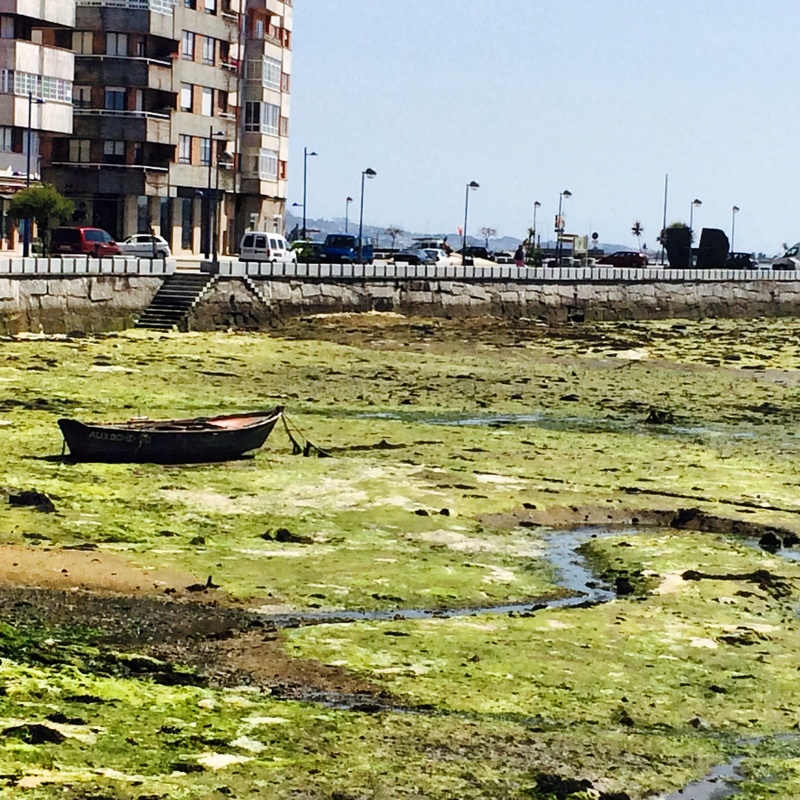
The sun was shining and the wind was dancing off the sea. Adrian took me all over the town, showing me only local things that I never would have discovered on my own. We walked along the sea at low tide, which was more like no tide, leaving vast expanses of green algae covered ocean floors and boats beached along them with their anchors still in the ground. Adrian said the sea changed every 45 minutes. Sometimes the water would be level with the road for a week and then be miles of beach for the next.

I’m like a child, skipping around like a curious 5 year old, asking every question that pops into my head on any given moment. “What’s that?” “Do you eat these?” “How do you say this?” “When do you eat this?” “But what are they?” “What’s this plant called?” “What is growing on this rock?” “What do you call algae?” “Why is there so much green here?” “Does the algae get tangled on you when you swim? I hate that.” “Do you swim?” “When does it get hot here?” “Does it ever snow?” “Do young people vote?” “What exactly does the King do?” Adrian seemed to find this amusing and answered every question patiently with a delighted grin.

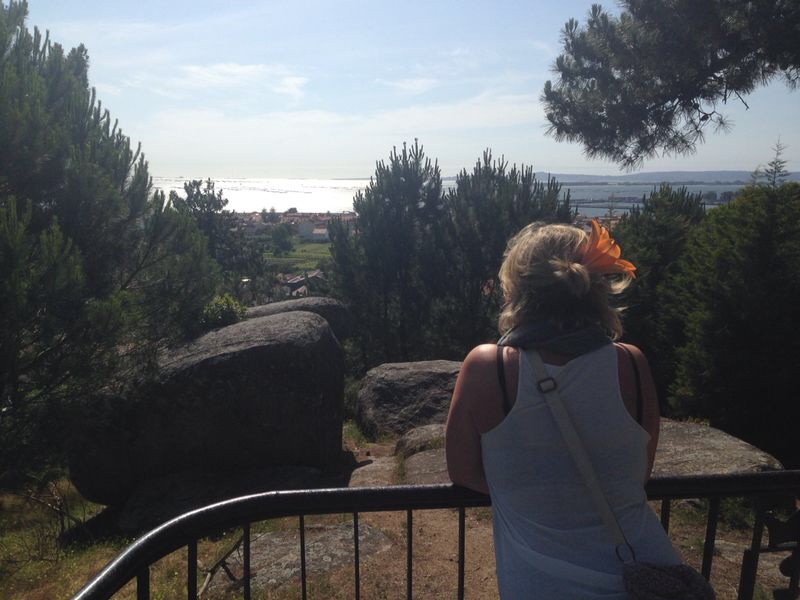
We walked to the ruins of a look out tower and climbed up, sitting on the rocks of what used to be a wall with the water splashing up against the stones below, while a man fished beside us. Walking through the town, we pass houses covered in shells (an old Galician architecture meant to protect the buildings from the coast’s weather conditions), and through a beautiful, old cemetery. It was covered in tiger lilies and after telling Adrian they were my favorite flower, he plucked one straight off a grave and put it in my hair. Certain that we were now going to some sort of doomed after life for that, I ran out. We climbed up a hill covered in a pinecone forest, which reminded me of home, up to a look out at the top. With Adrian’s help, I climbed to the top of the boulders and sat up there for awhile, out of breath and awe struck, overlooking the seaside town. The wind danced through my hair peacefully and I wondered how I could have come through Spain never knowing that this little town existed.

Once down on level ground again, we walked to a small winery. Albarino vines covered the Galician landscape like ivy roof tops, standing straight up, taller than me, and arching over one another to form a canopy above our heads. There were grassy floors dusted with flower petals and ponds covered in lily pads. An old man rolled an ancient looking, open barrel six times the size of him into one of the ponds to wash it, sending the lily pads soaring out on the waves. It had to be without a doubt, the most romantic setting that I had ever come across and I wanted to bottle it so that I could take it out for the perfect moment.

Aside from Albarino, there was another wine Cambados was known for … an underground, unproduced, unsold wine – Black wine. It was never labeled and it technically did not exist. Home made and home served, it was only served out of people’s garages. A piece of fennel in somebody’s doorpost meant that they had wine and to come on in. We sat in one such garage, complete with folding tables, and the man of the house grilled up spicy peppers for us in garlic and olive oil- complimentary with your massive mug of black wine. It was for all intensive purposes similar to a very dry, harsh, red wine but it was deep, deep purple – almost black – hence the name. It stained your mouth purple for days and if you got it under your fingernails, your fingertips would be stained for weeks. Local old men played cards at the long plastic fold out table we sat at and it was just another regular afternoon in Galicia.

Later, we met some of Adrian’s friends at an outdoor café in a square full of aggressive youngsters playing football. We drank a café liquor and I was becoming increasingly hazy at this point after all of this intense Galician alcohol. Adrian’s friends were interesting to say the least. There was Goyo, who was by all intensive purposes black inside, obsessed with American rap and NBA. Nebraska looked American but he was Galician through and through. The only English he knew came from video games so he would say things like “Destruction!” or “Carnage!“ I am told he was the town badass that used to have long blonde wavy hair down his back and hold the wildest parties known, but he is clean cut now and sporting a Nebraska sweatshirt which I thought a very odd American state to make it’s way here out of all the rest. And thus, I deemed him Nebraska. Adrian played guitar and sang in his low growl of a voice and we all laughed and sang for hours.

The next day it was raining. It rains everyday in Galicia, but in Galicia, they say that rain is art. If you haven’t seen Santiago in the rain, then you haven’t really seen it. All of the colors change. Personally, I preferred the colors in the sunshine, but I was down for the artistic view.

We go across the sea to the Island, which Adrian pronounces “Iceland,” (the silent s is not a concept yet accepted here.) We ate Pulpo (octopus) in a small corner street bar that up until 30 years ago had been the island doctor’s office. The people here still refer to the place as the “Consulta.” It is the best octopus in Spain (Galica hoards all the best seafood in the world and only exports out the crap) and I am told that the creatures have to be punched and beaten in order to soften them before cooking. You used to see all of the local fishermen smacking the live pulpa against the ground and docks after they came in for the day, but now a week in the fridge achieves the same job. Still, you must scare the octopus right before cooking it to ensure the utmost tenderness. Cooks torture the creature by dipping it in and out of the boiling water several times before submersing it. It all seems very cruel, but the pepporcini and oil covered sea creature is so delicately delicious that I cannot protest.

We eat calamari too (unlike any I have ever had), drink Albarino - unlabeled like all wine in Galicia, it just comes in a naked wine bottle, and watch the Spanish news on TV. The King has decided that he no longer wishes to rule- bored with his current responsibilities, so he has left the throne open and hopefully claimed by his son. The news station flashes to a clip of Obama, whom they call the most powerful man in the world, doing pushups in a suit on a basketball court and sinking lay ups. I am instantly embarrassed to be associated with this nation. It looks like we do absolutely nothing. Not even the President has any worries.

That night 2 American couch surfers, currently teaching English in the south of Spain are joining us and I am so excited to have comrades. Trevor from Wisconsin is outrageous and fluent in Galician. Tall and blonde and skinny, he eats more than the three of us combined and remains rail thin. Fallen, also super thin, is beautiful. She is Trevor’s roommate and originally from Texas. Dark hair and dark skin, she could easily be Spanish herself.

Trevor falls with a wicked flu of some sort or food poising, but it’s impossible to tell from what since he’s eaten everything. Fallen, Adrian and I go to a music festival called “Green Corn” full of dauntless looking individuals. Anarchist hippies with dread locks, and piercings everywhere, all in dark browns and army greens. In Spain, they call hippies “para floutas,” translating to dog flutes because they are always with flutes and dogs, which I find hilariously brilliant. No one neuters their dogs here, so they are everywhere- some with overfull utters that drag on the ground. We dress up in Panda suits – full head to toe, ears and all, panda suits – because I guess that’s a thing here and stay up all night with the music.

Aside from the actual performer’s on stage, back at the tents – all of Adrian’s friends sit cross-legged in circles and lay sprawled out in the grass as they play a various symphony of instruments and sing songs all night long. I fall in love with a Spanish girl’s voice who plays guitar and harmonica and has my dream singing voice. She is by all visual appearances, a homely looking, 14 year old, American girl who has been homeschooled her entire life, but she is nothing like that at all. She can’t speak English but she can sing it, so when she does attempt to speak, she only speaks in beautiful, poetic words.

The sky is splattered with stars everywhere, like the artist standing in front of a blank canvas dipping his brushes into paint and swinging them side to side sending paint flying across the whiteness before him; they keep appearing more rapidly than the moment before. After all the singing and dancing that my little Panda self can take, I finally crawl into the tent around 6am and fall asleep instantly. (Side note: it is not a rough morning until you wake up sweating, face down in a tent on top of rocks as a dirt covered Panda.) Everyone is still drinking, banging on cans and sticks and playing guitar, singing in the rising sun. And since we have about 5 more hours here, there is nothing to do but join in.

Note: I am NOT a morning person.

Note: I am NOT a morning person.

Adrian and Fallen drop me off drunk at the bus station and help me find my bus. With an address written on my hand, a dead phone and mud-ridden ankles, I attempt to make my way to nowhere in Particular.

Convertibles, Country sides, & Castles with Adam

This hostel was pristine compared to the last. I had begun to think I had the 8 person bed room to myself after being there the entire day, but as luck would have it, my bunk mates came in at midnight and they all spoke English. Two 29 year olds from Denmark- Sophie and Aska, and a Pennsylvania bred American - Adam.

Sophie was beautiful and tall. Very, very tall. (In fact, all three of them towered over me and I spent my entire time with them jumping around like a child to reach their level for attention). She was a medical student in the great socialist Denmark where education was free and money was never a motive,  and had lived in Spain for 3 months a few years ago. Aska (pronounced Oscar without the r) worked in some sort of International Economics studying underdeveloped societies and he was hilarious. The type of person who is instantanly best friends with every single person he meets, whether he speaks their language or not. He was quite fluent in Spanish, but even if he met a distant language, he got by with dance moves, wit and charm that he had seemed to master universally.

And then there was Adam – a Cornel student getting his Masters in Viticulture and working in the Finger Lakes vineyards. (Seriously … the luck??) As soon as I discovered that he was in wine as well (which was approximately 3.5 minutes upon their entering of the room), and had an appointment with a winery the next morning in Rioja, I asked him if he wanted to take me along. He laughed and I looked down at him seriously from the windowsill where I sat cross legged with my lap top, “I am 100% serious,” I said, and so it was decided.

Adam was weird, but harmless and interesting and nice enough. A Viticulturist and an Ornithologist (which is the study of birds he told me after I informed him I didn’t know what that was), who drove a black Mercedes convertible he had borrowed from a buddy in Madrid. He was by all worldly standards, “hot,” tall and tan with crystal blue eyes, but by all definitions a total science geek stuck in an athlete’s body. He was the type of person who immediately offered you all of the facts on a particular comment or observation you might have made. An endless bank of random knowledge, travel and Cornel stuffed brains.

“I’m sorry, but rules are: top down,” He said as we got in the car with his finger on the button to open the roof.

“I’m sorry, but you clearly don’t know me yet. Top obviously down. Snow, rain or hail,” I responded sliding in the other side.

We were off and Adam looked like a child overcome with giddy pleasure as he drove. It was indeed, pretty amazing – the Rioja countryside and back roads with vineyards as far as you could see. Upon certain twists and turns of the road, we would look at each other and burst out laughing because this was just too cool.

“What are those!?” He asked, more to himself than to me, slowing down and pulling off the road into a gravel path in a vineyard. I looked at the vines next to me, wondering if he could tell what type they were just by looking at them. They looked pretty normal to me but I didn't know; maybe this particular patch had stumped him. My hand on the door handle, ready to get out and inspect, Adam reached around and grabbed Binoculars from the middle consol. (Yes, this kid carried binoculars and a heavy duty pair at that, because “you never know when you’re gonna see cool stuff,” he told me). As I was wondering why on earth he needed binoculars, when we could just get out and look at the vines, he positioned them up towards the sky.

“So cool,” He said under his breath. I followed his trajectory to two very ordinary looking, black birds circling above us and then sat rather gape jawed and dumbstruck as he pondered them, reversed, and then carried on down the road as if everyone did that.

“Sooo … you like birds …” I mused.

“Yea. Like I said, I was an Ornithologist,” He responded

Okay then. “A Viticulturist. An Ornothologist. And a Mercedes convertible. I have yet what to make of you, Adam Kane.”

He smiled, which was good, because as I later found, sometimes he laughed at my jokes and other times, my wit blew right past him, completely lost like a passing sound he hadn’t picked up and he remained blank faced like I hadn’t spoken at all. Which was also another absurd impossibility, because Adam Kane had bionic hearing. Seriously, he thought it was normal but it wasn’t. He could detect a swarm of bees or a faint bird cry from a mile away (I can hear him now correcting that fact that it was indeed not even a half mile away, but more like .1 miles). He simply refused to believe I couldn’t hear these sounds as well, and I wouldn’t believe that he did until we followed this mystical hearing to the actual source and I saw it with my own eyes. Once we found it, I would look straight from it up to him, studying him like he did with his birds trying to classify this strange breed. He seemed not to notice that I was watching him as he watched whatever it was that he was particularly engrossed in at the moment.

Overcome with the landscape, the wind in our hair, and the energy of the afternoon, we thought we may have taken a wrong turn so Adam pulled off on a side road to look up directions and call the winery.

“I hear birds …” I teased in a sing song voice as we sat on the side of a silent road by a very neglected horse covered in hay.

“Just common Sparrows,” He replied simply without taking his eyes from his phone.

Bodega Paganos was a beautiful property set in the valley surrounded by the Iberian mountain range. Bright, leafy vines stretched out from the white, rocky earth and surrounded the stone fortress that stood between them – built from the “Mother Rock” that lie way below the earth, which they tunneled out to make their aging caves. It was a 5th century winery with an all-star wine maker named Marcus who had been voted 3rd best in his trade by Wine Enthusiast Magazine. Our host, Alberto, was without a doubt the nicest person in the entire world. The tour was meant to be in Spanish (Adam was fluent in Spanish of course. That year and a half he spent living in Peru studying plants or birds or whatever it was he did) and I was ready to smile and nod and suffer through it, just grateful to be there, but Alberto insisted on English for me.

He took us out into the vines and talked about all of their biodynamic processes with Adam. There were a lot of viticulture terms in broken English and Spanish and a lot of smiling and nodding on my part. Paganos’ vineyard cycle was planned entirely around the moon’s and each date out of the year was marked accordingly for the best leaf days, flower days, and tasting days. Because Paganos did not use chemicals or fast acting enhancements, the vines had to be cared for as if they were infants, each day of the year. Paganos produced four small quantity/high quality wines that were each named after their respective vineyards and yielded their own distinct personalities accordingly. They also made a larger production wine, which by Rioja standards of 8 million bottles a year, was fairly small at a mere half million.

Inside the winery, Albertos, showed us the equipment and took us through their version of the wine making process. I was amazed to learn that for the four top quality wines that they produced, each grape cluster was de-stemmed by hand, one by one, grape by grape, to assure the utmost quality and preserve the grape’s integrity. Instead of the common Bladder Press that I was familiar with in America, Bodega Paganos uses a Basket Press to extract the juice. Alberto explains to us the difference with an analogy of a teabag. The Bladder Press, he says, is like pressing your spoon to the teabag against the wall of your mug in the hot water to extract as much flavor as fast as possible. The Basket Press is like dipping your teabag in and out of the hot water by its string, oozing flavor into the water slowly but softly. This he said, was more time consuming but gave the wine a soft elegance that could not be achieved otherwise. They also still crushed some of their grapes by foot in huge barrels that subsequently served as the aging barrels for the first fermentation process. The secondary fermentation (Malolactic) was done in French and American oak barrels and in an entirely natural process that took from December to June to be completed. (The previous vintage was still in the barrel awaiting Malolactic completeion).

Paganos also made a wine that went through Malolactic Fermentation in what i believe is called an obom (an egg shaped barrel that pumped the wine in a certain flow used by the French for their whites; such as Chablis) and was 1 of 2 in the world to use this process for a red wine. Only 800 bottles were produced that sold for 1000 euros each. Albertos tasted three of the top wines with us outside against the vineyard and mountainous backdrop. They were divine (tasting notes at the bottom). He talked about each personality of the wine and told us that in Rioja, even his 2 and 3-year-old nephews study viticulture in school. He left us with a library of reading materials and invited us to a huge dinner and tasting on Wednesday night with the top California wine gurus. Instantly, a litany of curses against myself rang through my head for planning, for the first time in my journey, my next 3 stops, and transportation in between - all prepaid. I contemplated seriously about canceling my train and the next 3 after and just eating the cost in order to attend this dinner. (Later, upon meeting Adrian, I would end up unplanning all of these plans anyway.)

With a page full of places to see and eat from Albertos, Adam and I left to venture out to more of the Rioja countryside. The ride was heavenly, interrupted with spurts of knowledge and awe from Adam, like “Oh! Kestrel.” “Mini falcon. Super cool,” he would explain to me when I asked what the hell a Kestrel was. Or, the occasional screeching of breaks followed by, “Oh look! There’s a Quail.” Now thoroughly amused by my most recent case study, I began to play a game with Adam, pointing out every bird I saw. “What’s that?” “Magpie.” “That one!” “Piper.” But I couldn’t stump him so eventually I stopped playing.

We arrived at a small stone town and looked like two Beverly hills kids driving around in Daddy’s Mercedes Convertible. One old man stopped and stared, following us as we crept over the cobble stones. He said something aloud to those around him, which Adam translated as “Oh my God…” as he watched us. The town was otherwise abandoned and we parked to walk around.

“Do you smoke?” I asked him, pulling out a cigarette.

“No. Not since Peru.” He said.

 “Neither do I,” I answered, lighting the cigarette dangling between my lips. He laughed in an amused yet mocking way, which was exactly the response I had anticipated.

“Only when traveling alone in foreign countries,” I smiled, blowing the smoke out around us.

We ate pinchos at the only café opened in town and Adam made friends with locals and talked to them in Spanish for what felt like forever about castles and vines (I think). We explored a dark and cold empty church and snuck through a locked iron gate down into the basement. Unfortunately, it was just for storage. No catacombs. I tried to carve my name into a stone railing where others had but Adam grabbed my wrist when I pulled out the pocket knife and protested defacing a 600 year old church, so I didn’t. We drove about 5km down the road in search of this castle he wanted to see and stopped to ask a vineyard worker where it was. He told us to cross over the main road and follow the tractor up through the windy dirt paths, so we did. We drove up the narrow dusty trails with vines tickling the tires of the car on either side until we got to the top of a steep hill.

The castle was from the 8th century and completely abandoned. Without a soul in sight or ear shot, we climbed to the top of the hill and went inside. It seemed to be merely an open space covered in overgrown weeds and surrounded by stone but Adam found a place where he could climb the walls to the very top. (Adam was a rock climber. And a surfer. And a collegiate swimmer. Among other things. Obviously.) I made him get down immediately and lift me up first because I was too short to reach the foot holding and refused to allow him this adventure without me. Kicking my shoes to the side and tying my skirt up, I climbed to the top, through holes in the wall and then up again the other side until we got to the top. The view was absolutely breath taking. Mountains faded in the distance around us, enclosing the valley with thousands of miles of vineyards rolling up and over each hill and around every road and every bend. Not a patch went untouched by them. The bright sun glistened off the river below us, whose protection, Adam informed me, was the Castle’s mission back in 700AD; and the wind howled through my hair and whipped my skirt in violent fits around my legs. We were on the top of the world. We screamed as loud as we could and waited as it echoed off the mountains and throughout the entire valley. We sat in a comfortable silence for awhile just taking it all in and I thought I could most likely stay up here for my entire life, just sitting atop these old stone ruins overgrown with weeds and wild flowers, with my bare feet dangling over the edge miles above ground, and the wind caressing my face.

We drove back to Logrono, stopping at random picturesque views or bird sightings and then met back up with Sophie and Aska in town. We spent the night eating pinchos and drinking everything, going from tapas bar to tapas bar down the lively streets. I bought some snails (live ones; pets) off a tiny Asian man selling them as if they were flowers perched there on his tree branch, as he walked through the local outdoor bars. Then, not knowing what to do with them, I bought them all and set them free in a garden. The four of us followed some Logrono locals that had become Aska’s new best friends to a Karaoke bar down the street and sang duet after duet in English while the local Spaniards clapped, smiling ear to ear at every Backstreet Boys, Bob Dylan, and Bruce Springsteen song. I contemplated canceling my train again. I’m pretty sure I told everyone that I was going to. But I didn’t. My train left out of Logrono the next morning and I willed fervently for that one perfect day and night in Rioja to be forever preserved amongst the sea of new memories that I was headed straight into. 


TASTING NOTES: Bodega Paganos

2009 Sierra Cantabria ~ Deep purple hue. Classic Rioja spicy nose that lends into vanilla with time. Smooth, fresh mouth feel. A lot of grip without any bitterness to it and tannic structure without tannic feel. No over drying finish. 

2007 El Puntido ~ More complex notes. Dark red fruit and black currents. You can taste the oak. A nose full of white flowers after it opens up; Albertos says that it smells exactly like the white flowers of the olive tree blossoms in the area. Despite being a 2007, you can still feel how fresh it is. Complex, with a minerality characteristic to it, it is very well balanced with rounded tannins and covers the entire palate. 

2008 La Nieta ~  This wine has less oak and so much fruit - red fruits. It is bolder and powerful but also soft and elegant. It is not rugged at all like some other Spanish wines. 2008 was a great year in la Rioja. It has a finish that seems to last forever and a "high note" that Adam detects in the back of the palate. 

23 Things I learned in France
8.png

... in no particular order. 


#1. Probably plan out your entire journey before entering the country... i.e. where you are staying, what you want to visit, what times, etc. France is not one for improv.

#2. It has become strinkingly apparent to me that those who can only speak one language are inexcusably lacking. We are. Learn French. (or any other language at all). 

#3. Spoiler Alert: A "salted pancake" is dissappointingly, merely a lesser version of a quesadilla. 

#4. Heaven forbid you have a flat, car break down, or coronary heart failure, make sure it is either before or after lunch. Otherwise, don't hold your breath. 

#5. Don't pay for wine tastings. You can learn more in the cellar of a small family winery than you can in ten world renowned chateaus. (But, do call ahead. Refer to #4.)

#6. If Northern France is Miss Prim & Proper, turning her nose up at nude shoulders and thighs, than the South of France is her slutty little sister. (Topless grandmas everywhere.)

#7. I am almost positive that France will be the first country to go, if not solely due to lung cancer. Everyone smokes here. Every single person. It's like they haven't figured out it's not cool anymore. 

#8. People look at you like you have 5 heads when you tell them you are driving 7 hours to the other side of the country instead of flying. Your country is the size of Texas, people. We take 10 hour road trips across states without a second thought where I come from. 

#9. Eat at the right times. Walking into a restaurant asking to eat at 5pm is inconceivable. Of course they don't have food again until 7:00 ... what were you thinking? Also, don't ask for just a drink at a restaurant. That's what bars are for. You come to the restaurant, you eat. 

#10. Train stations are extremely diverse. One will have a pianist serenading you on a baby grande and your 3 hour lay over at the next station will not have any working bathrooms. 

#11. 100% set out to get lost in every new city you come to. Turn down street corners just because. Sit at outdoor cafes with no clue how far your place is from there or how to get back. It does wonders for the soul. 

#12. The mystery of French McDonalds'... 

a.) Certain ingredients that McDonalds cooks with in America are illegal to use in France, resulting in far less greasy and salty food. (Side note: two of my Parisian friends actually threw up the first time they had McDonalds in the States.) They have ... wait for it ... Deluxe Potatoes, which are in fact the most wonderous of things. They have weird sauces like "Creamy Chips Sauce", "Curry",  "Dressing oil Hazelnut", or "Saffron Maple."

b.) Contrary to one's plausible assumptions, they do not overwhelmingly love Americans here. Even though, WE invented McDonalds. 

c.) There is an abnormal amount of cute, young girls working in these places (as well as grocery stores). Haven't quite figured that one out yet. 

#13. No one knows where Maryland is so just tell them you are from New York. They will immediately treat you like you are a star. (Just tell them you are when they ask. No harm done. Their dreams come true; your dreams come true. Everybody wins.)

#14. Little kids are extremely entertaining to talk to. They will spill out a litany of, I'm sure, utterly cute things, to which you will not understand. When you attempt to answer them in English, their faces contort in incomprehensible horror like everything they knew was a lie. They will stand there for awhile, blinking violently at you as you watch them question their own sanity and then run away and never come back. 

#15. Check out is at 7 am and the maids come in at 8 am whether you are dressed or not.

#16. There is too much good wine in this country to comprehend. It is mind bendingly overwhelming and paralyzing.

#17. Don't assume someone understands you if they smile and nod at your yes or no question. They don't. The answer is not yes.

#18. Common misconception tells us that the French smell due to lack of hygiene. They do, in fact, smell, however, I believe the fault may lie in the deodorant companies because the stuff simply does not work.

#19. Serrano ham (Jambon) is everywhere which is needless to say, awesome! That being said, if it's on a menu and you can't physically see it, you might just get plain old, slimy ham. Oh, and bacon, is just ham. So before your morning is ruined, don't get your hopes up when you see it on the menu.

#20. Nothing is pronounced how it is spelled which makes sounding out the words utterly worthless. Not to mention, you look like a complete fool if you even try. If you do make friends in France (good luck with that one), you will never know their names because no matter how many times they repeat it, it just sounds like a beautiful river of flowing sounds. You will evidently butcher it repeadetly if you remember it at all. (Write it out for me man, now look at it... write it out again how it sounds. You tell me how I was supposed to know!) 

#21. The most culturally diverse town in France is, without a doubt, Lourdes. It is a very powerful thing to witness so many people who can't understand each other come together over the one Faith that unites them.  Every single language, every single country .... without any chaos at all. It might be the most peaceful place I have ever been. 

That being said, I must point out my regular strange observances: There is an overwhelming amount of Italians. So much so, that people say Lourdes is actually an Italian town and not a French one. No one thinks it is comically absurd to have a conversation with 3 Guiseppes at the same time except for you, so don't laugh in their faces when they introduce themselves. They will only stare back at you with blank faces. Every restaurant is Italian even if it is run by the French and there is an entire quater that only Italian pilgrims are allowed to stay in. And never will you see so many of the exact same stores back to back as in Lourdes. It's like 58 Sunsations for Mary in a row. 

#22. And this one I cannot stress enough .... these people CANNOT drive. And I CANNOT drive in their country. If you do decide to rent a car, and even if for only one day, get insurance!! Hence, Joffre's flat tire and the night rider who blew through Megane's (pronounced Meh-jah-nay, second car) side mirror while I was sleeping. 

#23. It's oui, not wi. Mind officialy blown. 

Prison Camp
7.JPG

It´s dark and cold before sunrise and I´m waiting at the train station for this bus to get me out of France. But it hasn´t come yet and I´m beginning to have this irrational fear that it won´t and I´ll be stuck in this country forever.

My head ached and I was tired as hell. having spent the past two nights in fits of insomnia, as I often do. My bus was departing at 6am and I wasn´t going to get to Spain until 8am and then wouldn´t have a place to stay until 2pm. Waiting at the train station, which was closed except for its doors, I eventually found a Little Wayne looking mother fucker (excuse my French but there is just no other way to describe him so plainly) who spoke English (of course) and told me where the bus would be. But now 6am was approaching and I was beginning to doubt the master rap artist. I walked outside to check and tripped over some luggage with it being so dark, only to realize that it was a man in a sleeping bag spending the night outside the station on his backpack.

Well, as it turns out, Little Wayne is a liar and the bus was not where he said it would be. No surprise there. It was 10 of 6 and I had been instructed to check in 30 minutes prior. Now I was panicking and running down across the street to the bus stop where two busses had just pulled up. Neither were mine so I waited alone in the dark. 6:00, 6:05, 6:10 ... I was officially stuck in France.

A comedy of errors type family strolled around the corner approaching the bus stop in a frenzy. An older couple accompanied by a mad man and 7 rolling suitcases. The woman, she must have been in her 60´s, began speaking to me in rapid fire French questions before she realized I only spoke English. She instructed me to converse wit her son who spoke my language. He did not, by any accounts, speak English. Mumbling incoherent sounds at me and spraying my face with spit, he only shouted his words louder when I told him I did not understand. I just shrugged and took a seat back on the bench. I was too tired for this. I watched them bobble about like fools, shouting and scurrying like finch about each other among the route signs trying to find their bus. The son, leaving his luggage in the middle of the road, stumbled to the building next to me and began urinating … loudly and for an abnormally long time. The parents didn’t seem to find this unusual. So again, I shrugged.

The night leaker came out from behind the building with more speed than he could carry and I watched him topple out over his suitcases, landing on the pavement, and sending his red, white and blue snow cap flying further into the street. I didn’t help him. I didn’t even move. Neither did his parents. It was all very strange and exhausting and the only thing I kept thinking was: Please let my bus come and please let the hostel allow me to check in early so I can sleep.

I had overspent and overindulged in private rooms the past month in France, unable yet to succumb to the dormitory life with strangers, but after inconceivable expenses between that and the car, I decided that June in Spain would be the hostel life. The hostel was in Bilbao and just for 1 night on my way to Logrono. Located directly behind the Guggenheim in town, it had looked cheap but promising. (Although, the website displayed no pictures of the bedrooms themselves, which is in hindsight, an obvious red flag). I arrived at 8:30AM in the rain and knocked on the front door of a glass cage of a building until a woman let me in.

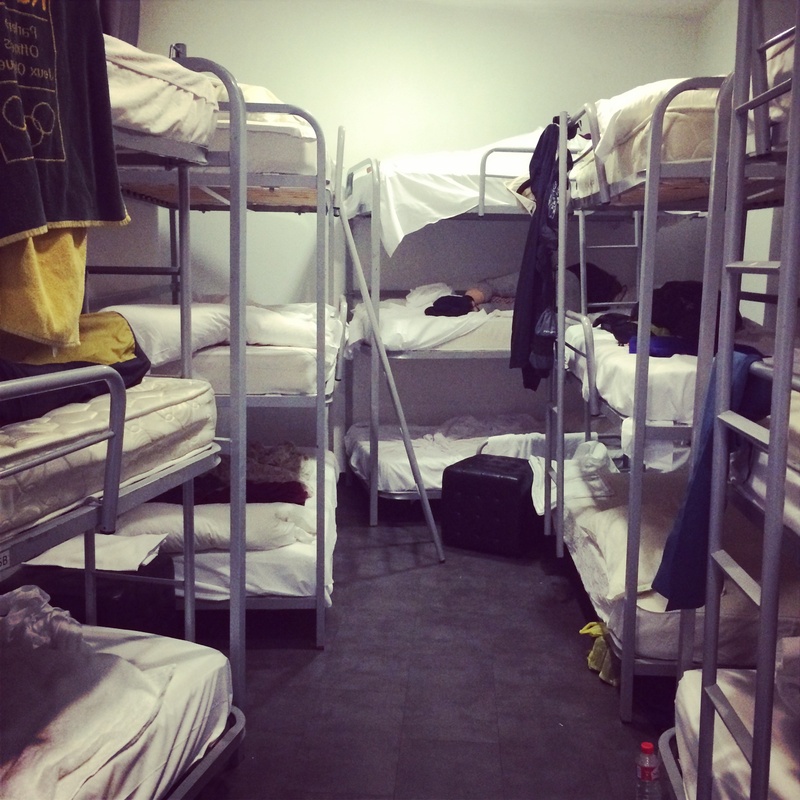
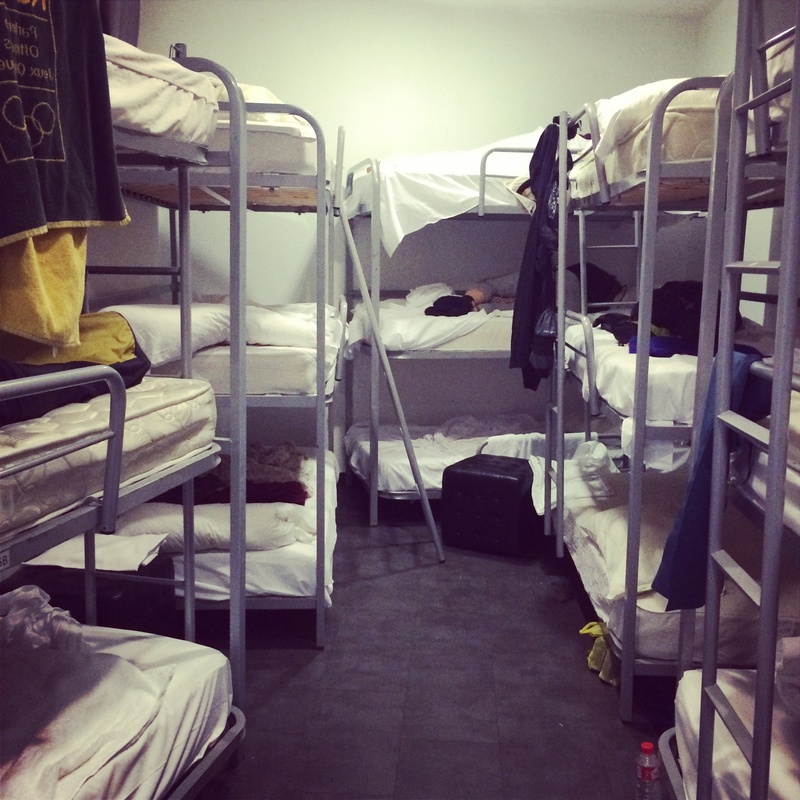
Boxto Gallery Youth Hostel was a hideous place and it reeked of a thousand sweaty backpackers. The boy at the counter running things that day could not have been over 17 years old and he took his time serving an array of old milk and stale bread as breakfast to those who were already awake. Finally, he took me into the room with a sheet and a pillowcase, placed them on the top bed of a triple bunk squeezed in-between dozens of others and pointed to my locker. I was inmate 24B. In the quarantined section of the barracks. The room was open with only a curtain to separate it from the common room and a half a dozen people still lie asleep in their beds with their sheets over their heads, the lights on, and raucous coming from those already awake in the shared space. Ok, Kristen … now you are backpacking. Deep Breath. Just embrace it. I put my luggage down and with sleep as the only goal in my line of sight, climbed up the rickety metal staircase to the top bunk, avoiding the death glares from the sleeping bunkmates and the grunts of the girl whose arm I had stepped on climbing up. I brought my valuable possessions backpack and my purse up with me despite being forbidden to do so, and sunk into a deep sleep despite the lights, noise, and stench.

I get a juvenile flight of butterflies like a middle school girl every time I overhear someone speaking English with an American accent. I had just woken up due to the influx of voices awakening, who were most likely consequence of the miserable hostel maid sweeping up trash and plastic cans while slamming her broom into the metal poles of the bunks and crunching plastic bags under feet. It was two of them- the voices - a girl and a boy and they were definitely American. Lyna, a young Greek goddess and Bob, her best friend’s brother, whose arrival they were awaiting. Chicago bred, they had just traveled from Amsterdam and were meeting Bob’s sister Colleen who had studied the previous semester abroad in Bilbao. I chatted with them for a bit before venturing out to explore the town on my own and knew that upon my return, I would be attaching myself to them for the night like a little sister tag-a-long.

Spain was loud and chaotic. There were music, children and dogs everywhere. (Which painstakingly made me miss my little brother and my dog). The people talked faster than anyone I had ever met and the Spanish I thought would come back to me had failed to do so thus far. But at least, I had more to work with here than I did in France and menus were easier to read. The air wasn’t quite as soft and romantic as dreamy France, but it was charged with an infectious energy that I loved. Accordions and violinists filled the streets (literally, there is one standing over my shoulder playing in my ear as we speak and he won’t go away) and tapas were spread out across every bar in town and up for grabs… beautiful little creations of bright colors, meats, thick sauces, herbs and seafood. And ham… Ham was everywhere, huge thighs dangling from every bar ceiling grazing the bartenders’ heads – hips, hooves and all.

I latched onto the Chicago trio that night and Colleen showed us her town as it had been for the past 3 months. We ate pinchos (tapas) out in the square where every bar was on the honor system. No table service and no credit cards held, you took your tapas, ordered your drinks and went outside, and then came back in amongst the crowds when you were done to tell the bartender what you ate and pay. We stayed up drinking and laughing about the terrible accommodations we were currently subjected to and this crazy, old Camina lady that we had met earlier that day backpacking and walking her way across Spain and staying in a youth hostel. They told me stories of their recent journey through Munich, Brussels, and Amsterdam and I traded stories from my past month in France. Colleen had accidentally walked through security at the Amsterdam airport with two lighters and a bag of weed in her jacket pocket (which they later smoked out of an apple), Lyna had had her 21st birthday in Amsterdam where a room full of strangers sang “Happy Birthday Nina,” to her (a name she kept for the rest of the trip), and they had stayed in a hostel infested with rats. It felt so good to be with Americans for the first time in a month. I climbed up into my third story bunk bed and had a surprisingly good four hours of sleep before waking to catch the bus to Logrono. 

The Old Mercer Bridge
9.JPG

Although, I was thoroughly ready to leave France, I had one more pit stop before Spain - Bayonne, a small commerce city by the sea. Two more days to taste France before it was gone and I wasn't about to waste that. 

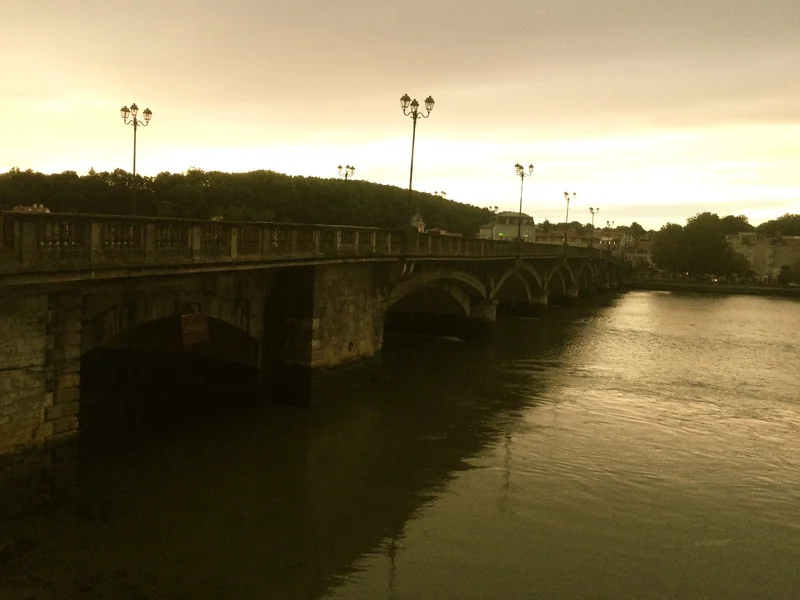
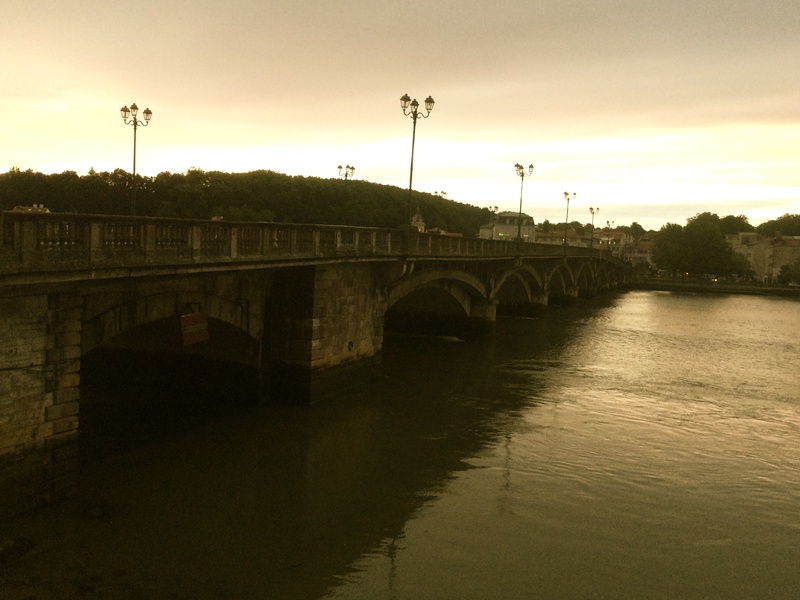
It's strikingly alarming what a little sunshine and warm weather does to me after four very cold and very rainy days. The Ibis Budget Hotel was souless and unremarkable, aside from the pleasant desk clerk, but it did what it claimed to do. Not knowing what I would do with two days here, I took a taxi into town that night. My first impression of Bayonne as a dull and colorless town surrounded by commercial hotels, jiffy lube type garages, and a KFC, was instantly replaced by an ever-renewed joyful wonder as I crossed the old city bridge. The sun gilstened off the water and the air was light with laughter. It was nearly 8:00 pm but the sun felt like 5:00. 

As I crossed over the middle of the bridge, my feet light again, I saw a tiny thing of a woman, ancient as they come, with two ski poles for walking sticks, straining to peer over the bridge. She couldn't have been more than 4 feet tall and the stone railing nearly reached her chin. Just as I neared her, she spun around and began to speak to me as if she had been awaiting my arrival, or anyone's for that matter. She spoke to me in French but I had the distinct notion that she had just started in the middle of a sentence. I apologized and told her that I did not speak French. 

"Oh heavens, dear. I'm an English woman," she replied in a British sing song way that only they are capable of. "Do you know what these are for?" She said scruitinizing the ground, tapping one of her ski poles against a line of metal grooves in the bridge's sidewalk. 

I suspected she was going to go into one of those old woman tales where they tell you the history and origin of the bridge and precisely the purpose the metal grooves served so very long ago. I shook my head, no, I didn't know. 

She glanced back over the side of the bridge again to the water beneath it. "It simply does not make any sense." She looked back at the metal grooves. "They look like tram tracks but they just stop here. What on earth would a tram need tracks for coming in from the sky?" She looked back at me. 

I had never felt so monstrous as I had then, looking down on this small creature. Her red and white ski poles looked like the newest arodynamic prototype in olympic skiing and downright comical with her shin-length brown skirt and soft pink sweater. I glanced down at the tracks as she had instructed, and then the road where they stopped, and then to the other side of the walk way where they picked back up again, perfectly in line with this side. 

"Well, I don't know." I said charmingly, returning my eyes to her with a smile.

"See if you can get a good look down there, honey," She nudged my bum with her ski pole, pushing me to the bridge's wall. "And see if you can figure it out for us."

I pursed my lips in a smile. She was serious about solving this mystery. Craining over the side of the bridge, looking down at the stone supports coming out of the water, I really did try to figure it out ... suddenly intrigued. 

"A draw bridge, maybe?" I asked looking back over my shoulder at her. 

"No, no, see they don't cross the road." She pointed to the street with her pole again. 

"Well, I believe the bridge has stumped the both of us." I said returning upright and facing her. 

"Where do you come from child?"  She smiled up at me. 

I have this bad habit of not knowing what to do with my eyes or where to look when people are wearing sunglasses. (How are you supposed to have a conversation with someone while looking at your own reflection?) I scanned the little white tuft whilting on the top of her head, looking for a spot, and then settled my gaze on her mouth. Her teeth had clearly began giving up on life long before she did. Browning from the bottoms up, I thought if I stood here long enough, I could watch them decay all the way to the gums. But she was English and we can't blame them for terrible dentisitry, right? Only America manufactures smiles. 

"The U.S. ... America." I answered, watching her mouth as it twitched into a crooked grin.

"Oh! Do tell where!" She responded. 

I had gotten used to Maryland being a dead end answer, but I said it anyway and went into my air diagram of where it was in relation to New York. 

She interupted with a laugh. "Yes, yes! I have family there. That city ... the one with the B."

"Baltimore." I answered.

"Yes, that's where they live."

"Oh, wow, most people don't ..." I began. 

"Or is it Boston?" She looked down at the ground and scratched her chin with the wrist strap on the top of her ski pole. "Wait a minute. It's Boston."

I smiled and began again, "Oh, Bost...."

"Birmingham? I think it's Birmingham. Yes, is that in Maryland?" She looked back up at me.

"Maybe." I smiled.

We carried on in that way, as if she was certain I had been her granddaughter in another life (although she did not propose the idea). So much so, that I considered I may have been. People passed by, strolling baby carriages, walking dogs, laughing ... because that's what people did on bridges - they crossed over; they didn't have family reunions. She caught me up on her life presently as if I already knew the first 70 years of it. I implored further. She had fallen for a French man, "by no fault of my own," she added, while traveling when she was young. They fell in love and married and he moved to England for the better part of his life to be with her. Now retired, he had insisted that it was his turn and so they returned to France. 

"We moved to {a town whose name I have no recollection of}, but Henry said to me 'Well this is just as much damned fog and rain as England! I won't have it,' so we went south and here I am." She smiled as if she had just announced herself. 

I was surprised that she lived nearby. With the curiosity that she took with the bridge, I had assumed she was on vaccation. Sadly, I wonderd if she had stood here before, maybe many times and tried to solve the same puzzle like it was the first time these tracks had stumped her ... every time. The conversation flowed with ease and we were genuinely interested in each other. She was so tiny and cute, I wanted to fold her up and put her in my pocket, so that I could pull her out whenever I felt particularly curious about something. Not so that she could give me the answers, but merely so she could demand them with me. 

We were so engrossed in one another that I had hardly noticed the woman who had stopped and was facing us on the sidewalk, mumbling some French nonsense. She got a bit louder and I turned to her and said,  "I don't speak French, I'm sorry," and then returned my eyes to the old woman's cracked lipstick mouth which hadn't stopped speaking. I didn't know if she was ignoring the stranger or was simply on the verge of going blind and deaf. 

"I speak English," the crazy woman slurred at the sides of our faces. "I need money. I'm saving the world." She stumbled closer with her hand out and my gaze met her again.

She had hair the color of straw that stuck out like it had been pressed by an iron every day of her 45 year old life. She wore a coat made for a Mt. McKinley voyager, and had 5 scarfs on, all of different colors, shapes and sizes. Her teeth made Miss Ski Poles look like Mono Lisa and she had two different shoes on. I could hear Ski Poles effortlessly continuing her story without having missed a beat. 

"I don't have any cash. I'm sorry," I looked back at the minature woman, trying to concentrate on her tale and pick up what I had missed, while minding this narcotic nutcase encroaching on my right. 

"You don't understand. I. Am. Going. To Save. The World," She said indefinitely. The words came out messy, coated in slime, with the stench of a frat house after week old kegger.

"Yes. Yes. Well go, on now then. Go save it," The old woman said in that same upbeat British song that makes it impossible to differentiate between scold and praise. She waved her pole at the woman's legs, shooing her away and returned to me, picking up the sentence as if she hadn't ever broken it. 

A few more slurs on her way out and the woman retreated. I tried to surpress my amusement as the woman carried on her tale, unaffected. I bit down on my lip to keep attentive, but my eyes betrayed me and I could feel them laughing.  

"What's your name?" I asked when she finished. It seemed inconceivable that I didn't know it. We had been friends for years. But I had learned that in France, people don't feel the need to introduce themselves on the way in or the way out.

"Mercer. Betty Mercer," She answered.

I smiled. "Well, it was very nice to meet you, Betty."

"You too dear. I'll be going now." She flashed me surely an award winning smile in the dead teeth category and scurried along on her ski poles, never caring for my name. 

I couldn't stop myself from smiling as I left her, each of us going in opposite directions. I looked back over my shoulder to watch her hobble along, searching the sky for a tram to reclaim it's tracks on the bridge. I wondered how simple and delightful the world might be if everyone was as trusting and easily trusted as Betty Mercer. A world full of candid, curious Betty Mercers. I laughed. What a wonderful place that would be. 

I realized then, that even if she had stopped on that bridge a thousand times before with the same new sense of curiosity, her life was better for it. Anyone's would be. The city, despite how long she had been there, had not been dulled down for her. Time had not succeeded. Ever captivated by those infinite possibilites that we all feel creep up within us again in a new and beautiful place. Perhaps that was life's gift to her at the end of her story. A ceaseless spirit of childish wonder. I couldn't fathom a more wonderful way to live. 

Road Trips with Joffre: Part 3

DISCLAIMER: Dad, I didn't write this one either. Probably, just don't read any posts involving cars or road trips. 


The Final Chapter : Bonnieux to Bordeaux

Someone really should have taught me how to change a flat tire BEFORE I left the country. And while I was at it, I probably should have learned French as well. Two skills seemingly unrelated, however, as it came to be, I was in need of both of them at the exact same time.

The morning started off more than fine, with the smell of excitement and promise in the air. Putting on my favorite gypsy dress in order to coax that joyful freedom out of me (as I often did) for this 7 hour road trip, I set off from Bonnieux with Bordeaux in my horizons. Joffre and I were getting along quite well and I gave him a pat, the way you would an unreliable horse, to let him know that he was doing a good job and in hopes that this reassurance would keep him from bucking you off in the near future. Cursing him for his foolish errors and apologizing for mine, our usual banter carried on much the way it always did for the first hour of the trip.

No sooner had I settled into confidence with Joffre, he decided to crap out on me. Waiting at a red light, as he had instructed me to do, I then inched forward as it turned green (never truly sure who had the right of way, where I was turning, etc.) A loud, startling explosion noise, sounding much like a race car junkie with a crap car flexing his muscles through his exhaust pipe, had me searching behind and around me as I slammed on my breaks. I saw a motorcycle stopped at the red light next to me, but he was looking at me?

I carried on slowly making the left as Joffre had told me, and felt the road rumbling underneath of me. Well, I was either on the rockiest main road that ever was, or that explosion had been one of my tires. The rumbling didn’t stop and I saw more passerbys starring at me, so I pulled off onto the side of the road. It wasn’t by any stretch of the imagination a beautiful road, nor did it carry any clues that I was in France. Plain low cement buildings on either side with small inner city looking store fronts. I got out of my car, suddenly completely conscious that my gypsy dress and headband did not help me fit in in this town.

It was the front right tire. Completely flat. With no clue how to find a spare or fix the flat when I did, I opened the trunk and started pulling on the different levers to try to open up the floor. It wouldn’t budge. I scanned around me and immediately caught the eyes of a Mexican-looking guy (are there Mexicans in France?) smoking a cigarette and watching me amusingly. He was sitting in a plastic blue chair that looked like it belonged in a kindergarten classroom, outside of what looked like a tiny 711 knock off, with tobacco and keno posters covering the windows. I walked towards him silently repeating the mantra in my head I always did when I desperately needed someone to speak English (please speak English, please speak English, please don’t be a serial killer, please speak English.) He did speak a bit of English, but barely. His genuine smile was reassuring and he nodded at my hand gestures and failed attempts to explain that I didn’t know how to change a tire. Nodding surely because he had been watching me and clearly this crazy American girl dressed in outlandish gypsy garb could not know how to do such a thing.

He looked at the tire and then opened the trunk as I had done, trying to open the floor. Stopping, and glancing under the car, he said, “No tire,” with the cigarette still in his mouth. My jaw dropped. Well, apparently rental cars in France do not come with spare tires, among other things, because that makes perfect sense. The man, his name was Momo, (which I pronounced as Mohamed the entire time until he wrote it down for me when I left), gestured me to follow him while he called the rental company for me. It seemed that they had told him that they would come in 10 minutes, which is what I believed, but looking back, that couldn’t have possibly been what Momo had said.

After 25 minutes, Momo called again for me. But being 12:15 now, the French were eating lunch and everyone else, stranded or not, would just have to wait. I wondered if the police and hospitals here had that same policy. Everyone seemed to. So, I sat with Momo outside of his shop in a blue plastic chair with strawberry cartoons on it, and looked out on to one of the ugliest streets I had seen in France yet, smiling at every passerby that looked at me, as if this was exactly where I always spent my afternoons; with Momo outside of his shop, and yes, I always came dressed like this. We couldn’t understand much of each other, but Momo understood that I needed help and I understood that he was kind and that was enough. So, we faked the rest and laughed at each other’s jokes pretending that we understood them and hoping that they were indeed jokes.

After 45 minutes, we called the tow company again, but they were still eating, so we were still waiting. Momo’s friends had now joined us and I sat there forcing so much confidence, that I was sure it had turned my skin that Spanish hue, my hair dark, my dress into jeans and my headband into a baseball cap, blending me in to the rest. After previously declining, I motioned to Momo’s cigarette and decided to smoke with the Mexicans in their blue chairs, because, well, when stranded in Avignon with a flat tire and French Mexicans, why would you not smoke cigarettes with strangers in blue chairs? What else are you to do with French Mexicans? We had no other common ground to talk about and it looked like I was here for a while so I had better settle in. So that is exactly what I did, one deep breath and I was perfectly content here with the blue chair gang and their cigarettes. Simply letting the story write itself.

Two hours, two red bulls, and three cigarettes later, the tow truck finally arrived. In that moment, watching Joffre strapped to the gurney, I felt bad for cursing the bastard earlier. It wasn’t his fault – the flat tire at least. Without an ounce of English, he took us back to the garage in silence. 

Through means of translation apps (thank you Steve Jobs), and sign language type reenactments, the garage workers got the car on the lift and Enterprise on the phone. Turned out they didn’t have the correct tire, so I was going to have to pay for the flat, get a taxi to the train station and a replacement car there before the rest of my 6 hour trip. It also seemed that there was no Kristen Thomas in the Enterprise system; either that or there were 200 others like usual (thanks Mom and Dad), so that meant no record of the insurance I had purchased. No daddy or lover to swoop in and sort out the mess, all alone in a foreign land, I was finally going to have to learn to fend entirely for myself. On the edge of panic and the brink of tears, I took a deep breath and decided to embrace it all, choosing to live the chaos and let the book go on as it may.

After many phone calls and what seemed to be hours, they found that I had purchased insurance (thanks to the little voice always in my head that is my Father), and I wouldn’t have to pay for any of it. I packed up all of my things, which were strewn about Joffre’s insides, and we said our last goodbyes. Looks like we couldn’t make it all the way to the end, but we had a good run.


RIP Joffre. 

My Week with Marlboro
10.jpg

:: A Social Experiment ::

I bought my first pack of cigarettes – in my life, to date – in a very tiny, very blue convenience store, while stranded in a very tiny town north of the south of France with a flat tire, no language skills, and a cluster of French Mexicans.

I had been friends with countless numbers of smokers over my 25 years, lived with some and dated others, but never once was I tempted by the notion of smoking cigarettes. It simply had just never appealed to me. But thanks to the aforementioned predicament, I found myself smoking cigarettes with strangers and then in some form of delusional trance, buying a pack to smoke for the remaining 7 hours of my drive cross country.

Everyone smoked in France. Every single person. It was like nobody had told them it wasn’t cool anymore, that the youth had stopped smoking cigarettes back around the time of Y2K. I watched them chain smoke for the past 3 weeks, stayed up for hours with some of them while they emptied entire packs, and not once did I desire to indulge in this ugly habit. But somehow, Joffre, Momo, and that day got to me. (Please reference blog post: Road Trips with Joffre Part III.)

Carrying a cigarette in your hand in France is like putting on an invisibility cloak. Instantly, I was captivated by the magic of it – that this tiny thing can make my Americaness disappear. Suddenly, I am no longer out of place, but blending into the everyday city street traffic of France. Incredible.

Although I couldn’t deny my taste for the head rush, what I really liked was the power it gave me, and that cultural submersion I had been lacking. I felt so … French. Leaning out of my floor to ceiling window in Bordeaux, exhaling the smoke into the lustful French air, it was as if I had always been here. And to the outside observer, I had been. No one stopped me on the streets, no one looked at me as if I had the word TOURIST or AMERICAN tattooed on my forehead as I wandered around like a deer in the headlights. It gave me a mask and a poker face and I walked the streets alone at day or night, unnoticed and unimposing as a French girl who had walked these streets a thousand times before. Men didn’t call out or proposition me; locals didn’t give me dirty looks as I approached them before I even opened my mouth. No one really talked to me at all. And if they did, it was in French … which I noted extremely interesting as it had not been that way before these magical little wands between my fingers.

No one messes with a girl walking or sitting alone while smoking a cigarette. That girl has done stuff. She’s seen stuff. And she has no interest in your bullshit. She is unapproachable. Trust me I know, I’ve seen them and I do not talk to them.

Bordeaux was a gorgeous city, lit up and alive even throughout the night. It was, I thought, a city I could live in (at least for awhile that is). And now I felt a part of it. I could explore the city streets at night alone without anyone suspecting I was doing anything other than walking home from work like I always did. I suppose I could have pretended to smoke cigarettes instead of actually smoking them, but as it were, I came to like the warmth of the nicotine against the brisk chill of the October-like air. I also felt very writeresque leaning out my window in between smoke and scribbling ferociously in my journal. I know, I know, it was all very Carrie Bradshaw meets Ernest Hemmingway but I was doing it anyhow …. 

Saint Emilion Wine

Located 45 minutes from Bordeaux’s city center was St. Emilion – a beautiful and luscious wine region known for it’s red blends of Merlot and Cabernet Franc. Chateaus spread along in between vineyards of every shape and size. I visited Chateau Soutard who literally had cannons posted up for battle surrounding their vineyards ready to shoot ice out of the sky if it attacked and turn it into rain before it could touch the precious vines. Another, Cardinal Villemaurine, located right down the road still used horses to till their soil, expanses of untouched earth below to age their wine, and outdated equipment built into the walls to ferment it.

Chateau Soutard was an expansive and lavishly renovated winery, completed in modern redesign in 2006. Some top French insurance company had purchased it and outdone themselves entirely. I was in an English speaking tour – 2 Ohio residents, a couple from Toronto and a couple from England. The tour guide was young and good-looking – Jacques something or other, but his French accent was thick and his English was quite hard to understand. He would pause awkwardly after each paragraph and just look at us expectantly, like we were supposed to do something. But none of us ever did. I felt for him – it was a tough crowd. After a few very long, silent moments, he would motion us to follow him. Most of what he told us about the wine making process, I already knew, but I jotted down a few differences.

Chateau Soutard grew 80% Merlot and 25% Cabernet Franc with little Cabernet Sauvignon and Malbec scattered sparsely. The earth was made up of limestone with a sandy covered clay overtop. We went through the “old” and “historic” wine cellar, which Jacques claimed had been renovated to look exactly as it had 6 generations ago. I found that hard to believe. By the looks of the place, it was designed as a wedding venue or concert hall (a baby grand piano graced the center) and the 10 by 10 glass elevator that we got into was furnished with glossy benches and satin cushions. We rode the 21st century elevator to the underground cellar which looked entirely too new as well. It was all very wine cave meets 5 star Marriott in Time Square.

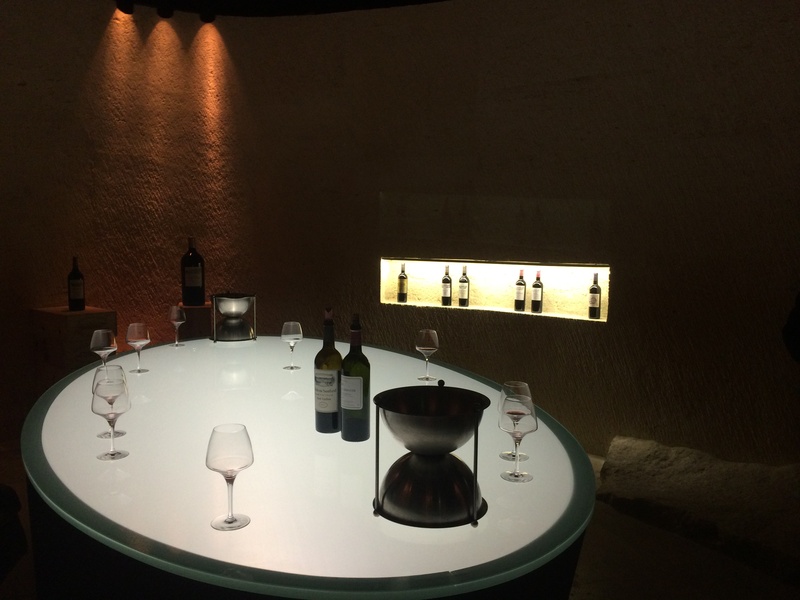
The underground limestone tasting cave was too perfect and you could tell it had just been dug out a few years ago, unlike the ancient quarries that ran underneath the rest of the city. Caged rooms held thousands of unlabeled magnum bottles which they used to age the wine because in them, the aging process was more slow and delicate. An oval, translucent table, glowing white from the center of the room, served as a bar and was meant for better inspection of the wine’s color. Jacques said that judging the color with these UV rays would allow us to detect the precise vintage of the wine. We tasted a 2004 and 2007 Grand Cru Classic (tasting notes at the bottom) and here, I did learn some interesting facts new to me about the process.

All of the wine made here was unfiltered and the light from the tables pierced the color in the glass revealing the floating sediment. Jacques said that only in the last 15 years, wineries have started to filter it all out but it was better to allow it to remain in the wine. He told us that the best vintages of Bordeaux in the last 14 years were 2000, 2003, 2005, 2009 and 2010. The St. Emilion wines could be aged for 25 to 30 years. But wines from Medoc (a neighboring region) could be held onto as long as 50. As the years went by for one holding onto a particular bottle, some of the wine would escape from the glass. If someone had purchased say, a bottle of 1979 wine and still had it unopened, they could bring the bottle back to the Chateau and have it topped off and re-corked from the Chateau’s stock cellars, which held spares of every vintage.

An American scientist from Ohio asked Jacques about the present cold, wet weather (a question that I was so tired of hearing that I almost answered it myself for the intrigued doctor) and Jacques told him that out of the whole year, these two weeks were the most important of all. The last time they had four very bad years in a row was 1960 and these years usually tend to work in cycles. After 2011, 2012, and 2013 all turned out to be bad years, they were expecting 2014 to unfortunately be bad as well. Saint Emilion had only harvested 40% of a regular season in 2013 and Bordeaux had only yielded 20% - a very bad year, indeed. I started to zone out from the weather conversation until I heard Jacques tell the scientist about their ice cannons. Should any frost decide to fall at an inopportune time, the cannons were aimed and ready to turn it to rain before it could reach the crops. That was it. Where the hell was I?

After the tour, I chatted with Jacques and found out that he had only been at Soutard for a month and was previously a wine maker in Virgina. He, like all Europeans I had met who visited America, seemed desperate to get back. He said that he much preferred the creativity allowed in American wine making because there weren’t nearly as many laws pertaining to the process as there were in France. I gave him my card and told him to go bother Boordy Vineyards if he wanted to move back.

After I left, I drove in circles trying to find Cardinal Villemaurine, which ended up being located right down the street from Soutard. I had just come from a vineyard with it’s own private fleet of cannons and these guys were out in their fields following 2 giant white horses in between the vineyard rows, tilling the soil with their hooves. I glanced behind me and could still see Soutard. This could not be right.

But it was. This 4th generation family Chateau was the real deal. About 1/20th the size of Soutard above ground, its expanses of underground quarries seemed to be never ending. We must have walked under the vines, the streets, and maybe even the city. I wondered if the roots ever broke through the ceilings of these limestone caves or if they just felt their way around them and down into the walls.

This Chateau had two brands: Cardinal Villemaurine – coming from many of their fields throughout the region, and Clos Villemaurine – coming from the clos on the property with the horses. They were Grand Cru, which meant they had to abide by 3 major guidelines. One: the alcohol content of their wine must be between 12.5% and 13.5%. Two: They must only use oak for aging their wines. And three: the wine must be aged for at least 12 months in barrel. Villemaurine aged their wine for 24 months and it was splendid (tasting notes at the bottom). They use small oak barrels to yield stronger oak flavors and large, burgundian barrels to keep more fruity flavors and then blend the two of them after 18 months for an elegant balance. The wine then returns to barrel to complete the remainder of the 24 month aging process. Like all of the French wineries I have visited, all of the bottles remain unlabeled, stored underground. They are "dressed" as needed when shipping orders come in. The tiny Vietnamease, French woman showed me a room containing all of the 2012 wine, still in barrel. The last blending would be next week and it would be in bottle by July, awaiting release in January of 2015.

The city of St. Emilion was amazing and so interesting. An entire city built out of limestone. They had dug into the earth to find it, leaving 200km of quarries under the city abandoned and unused. Many, many years later, the people realized that they had the perfect conditions for aging wine down there. So the beautiful Merlot and Cabernet Franc wines of St. Emilion lie under the earth, hidden from the city above and covered by the present generations of vines, burrowing their roots deep into the limestone below where their ancestor’s lived. I walked through the city and saw all of the negative space in the limestone caves below turned into its positive counterparts in each building. The rain finally stopped and the sun came out with a vengeance. I walked the streets around nooks and crannies of stone and fell in love. I decided that I simply couldn’t leave yet to go to the next region, so I didn’t.


TASTING NOTES:

Chateau Soutard ~

2004 Grand Cru Classic~  65% Merlot, 30% Cabernet Franc, & 5% Cabernet Sauvignon. Deep purple hue with a lot of sediment. Aromas of vanilla and cherries that later yeilded as more distinctively, white chocolate, raspberry mouse. Fruit bomb flavor. 

2007 Grand Cru Classic~  65% Merlot, 30% Cabernet Franc, & 5% Cabernet Sauvignon. Oddly enough, the aroma of this wine instantly made me think of charcuterie and basil. Almost like parmasean cheese. The taste reminded me of spice and pizza which was surprising and strange. I am told the spice comes from the limestone. This wine has high tannins and a very complex flavor. Later, the aromas open up to more fruit. Jacques tells us that it is best to open this bottle and let it breathe 2 hours prior to drinking. If it is a very old vintage - 30 minutes prior and if a very young vintage - 5 hours prior. 

Cardinal Villemaurine~

2011 Cardinal Villemaurine ~ 70% Merlot, 25% Cabernet Franc, 5% Cabernet Sauvignon. Aroma is reminiscent of Port like chocolate covered raspberries. Dry with red fruity and oaky flavors and light tannins. Very smooth.

2011 Clos Villemaurine ~ 80% Merlot, 20% Cabernet Franc. Old vines from Clos behind Chateau. Strawberry and cherry on the nose with stronger tannins. 50% aged in new French oak, and 50% in two year old French oak, which gives the wine more structure. Much more characterisitc of a Cabernet Franc despite being primarily Merlot based. 

Salsa with Santos

Julie took me to her favorite spot in Marseille ... the Quartre de Creatres, or the Quarter of Creators, the pulsing artistic square where all of the magic happens. I loved it the second we walked up the steps. There was so much creativity, expression, and life everywhere. Bright greens and yellows and reds were painted right on the stones of the street or walls; men sang regae in the streets and beat on drums and guitars; children danced around firecrackers; laughter bellowed out with young enthusiasts as they stumbled out of bars and danced to the music by the fountains. 

Julie and I sat outside on the patio. We had a few beers, and shared a few secrets, and then decided to wander the streets and find another place to sit. We walked down the side streets, and I was enamored by it all - the music, the crowds, the passion that drummed through everyone I passed. 


Enter Santos ....


Acrobat. Kite Surfer, Jungle Leader. Tarzan in the flesh. Speaker of 9 languages, wilderness hunter, wind surfer, salsa dancer, and self proclaimed spiritual leader, reader and healer. He pointed me out of the crowd and told me that my aura drew him to me. (Well, I had to give the kid points for originality). 

He didn't drink. He didn't smoke. And he did not wear deodorant. But he was spritual and alive in all sorts of ways. A sleevless cut off and jeans with dark skin and muscles he was far too proud of. He was Columbian and Moraccan, but had lived all over the world. (At least he told an interesting tale, if he hadn't.) He had a dangerous yet youthful face that made him look younger than he was and an energy to match. His curly dark hair hung below the nape of his neck in a thick unruly way. He was king of the jungle cats. 

He fervently believed that his spirit animals were not one, but three ... a black panther, a dolphin, and an eagle, but not just any sort of eagle and certainly not a bald eagle, but the most regal of them all. (This guy was 100% serious). Santos sat entirely too close and his eyes peirced you, searching, trying to read you as you spoke.

"You have an emotional burden resting on your left side," he spoke to me as if I would take him seriously. I looked down at my left shoulder which was the only bare shoulder I was showing and looked up at him cryptically. 

"Nope. I don't have any emotional burdens. I just like to wear my shirts like this," I responded.

He seemed flustered and readusted his feather rustling tactic like the peacock he was. He seemed cocky at first and that was because he was but over the night, he became something much more. Deep and spiritual if you could get through the weeds of strangeness. He wanted to take me salsa dancing. I wasn't interested in him romantically in the least bit. But what I was interested in was experiences. Stories. So I went.

There was another guy with us - a Messiah looking character, with hair that hung down his back, who carried a tree branch for a walking stick and was prepared to part the red sea at any moment. Santos was as centered yet ADD as they come. We would be walking along down a corner street and suddenly he'd be gone. Off changing lives. Scanning the area for him, you'd find him talking with a woman on a bike and embracing her as she cried, or with an old man having a deep conversation in German. 

He was an even more intense salsa dancer than he was a person. Whipping you aroud the dance floor in an underground, dark club. He would pull me against him rather forcefully and demand to be looked at in his eyes the entire time. I couldn't hold his gaze and would falter it to the floor as I tripped over his feet. His eyes were burning with an unmasked passion that you don't see on a day to day basis. But Santos was burning with a passion for everything. 

Unfortunately, Santos was a bit too intense and passionate for this world and I spent the next 5 days avoiding him, making up excuses and then telling harsh truths when they didn't work to get out of meeting him. Then bumping into him on the beach the next day and getting told off for my disrespectful declines from his attention. I told Santos that everybody was entitled to change their minds but he did not agree. He stormed off after a few choice words and I never saw him again. 

Star Crossed Paths
11.JPG

There are certain people, I am sure of, that cross your path for a reason. Whatever that reason may be, it matters not. But these people come into your life for a moment and change it indefinitely. Some call this fate, but fate is not what I am talking about. Fate has a preorchestrated conotation to it that leaves us little control over our destinies. What I am talking about is something different. It is being awake. Awake enough to see these persons when they come, embrace every moment when they are there, and then let them go as you both carry on your ways. 

Julie and Dial were such people. And I felt it before I even met them, and knew it beyond doubt once I did. 

Julie was an outrageous and incongruent burst of energy. No sooner had I walked through the door, she was greeting me with hugs and kisses and a smile that engulfed you. Welcoming me much like a great aunt, twice removed, whom you hadn't seen since you were 18 months old and had no memories of, would. But somehow, instantly you felt she had known you her whole life. She wore a bright red polka dot dress and her dark auburn, tightly wound curls sprung fron a short bob behind wide, cat eye glasses. I had no idea how old she was, but she was hilarious. 

We had Bastille (a Mersaille drink) at the bar below her apartment right on the beach and talked with the locals for hours. And by locals, I mean local drunks. Four old men crowded around me at the table, competing in French for my attention. Najib was a self- proclaimed wine conniesueur with a beautiful Indian wife, who schooled me the entire night about Bandol wine and all the wines of the world he had tried. There was a crazy skinny old man with a bad comb over that he had long since given up on and missing teeth. His hair fell stringy and long and he had a lazy eye that would scatter and twinkle after he made a joke. None of which I understood, of course. He seemed to re-forget that I didn’t know French in between drinks. The bartender, who did not look French at all, was a straight up Italian looking Guido from the Jersey Shore. Except without the muscles or the tan. He wore sunglasses the entire night inside the bar and despite the bulging pudge of his stomach under his tight shirt, he was the king of the house.

Julie and I shared her son’s room that night because she had other guests in her room. We ordered pizza, drank wine, and danced all night to all kinds of music. We did all sorts of things that week like exploring the town, hiking mountains to find beautiful hidden coves of crystal blue water, picnicked with jamon and melon, stayed up into the late hours of the night, attended house warming parties for friends which were conducted entirely in French, went salsa dancing with locals and shared stories from all walks of life.

One particular night, over two bottles of wine, Julie told me all about her life and family in Senegal, Africa. When she first arrived, she had all of her money stolen, which she expresses as a divine blessing. She lived in poverty with African families where they didn’t know where their next meal would come from and if lucky, had one plate of rice to share. She washed men’s underwear and clothes all day for 1 euro while they gawked and laughed at the irony of a white woman doing their laundry. She said she had never been so happy in her entire life.

“Africa is happiness,” she says with a joyful glow. “These people have nothing. Not a thing to offer, but their hearts …” She stretches her hands out as if grasping a beach ball in front of her chest, shakes her head and breathes out with misty eyes.

“Their hearts touch you. All the time they dance. They are the happiest people alive,” she finishes in her French accent.

Julie is the most genuine person I have ever met. She is a white, Jewish, French woman and her former husband is an African, Muslim muscian. Their son, Dial, is the beautiful combination of all things. Just 9 years old, he is exceptionally bright and struggles with his identity and lingering racism in school. He idolizes Michael Jackson and can dance just like him. He often asks his mother if he too, should bleach his skin white like Michael so he might also have white babies when he grows up. Julie attempts to explain to her son why his idol tried to appear as a white man and why he probably paid a donor for white children.

The whole thing is a concept so foreign to me that hits me with the weight of an entire building, crashing into me like a wrecking ball and sending my insides spiraling into pieces throughout space. And with every earnest look on Dial’s precious face, I want nothing more than to protect every child in the world from this feeling.

Julie wants me to go to Senegal and experience this way of living with her family there. Although the place frightens me, it intrigues me as well and I am tempted to visit. The three of us eat avocados drizzled in balsamic and more melon with Jambon for dinner, look at pictures of their family trip to Senegal, and dance to Michael Jackson for hours. 

Unexpected Finds

The best thing about France was that sometimes, you could almost forget you were in France (almost). You could be driving for miles down a road and one turn, around the bend, there is something out of nowhere that leaves you breathless, reminding you that you are, indeed, in France. 

I pulled off the main highway to find something to eat in Crozes Hermitage. The town was completely vacant so I kept driving. I stumbled upon this little village, Gervans, up in the hills. Everyone was closed for lunch, because, well, I guess they were home eating lunch. The air smelled of salt water, olives, and an afternoon ocean breeze. There wasn't a soul around. I drove up through the winding hills between the Spanish roof-tiled houses. The vines were everywhere and much further along than they were at home, flourished with huge, bright green leaves. There were no green lawns here, no pastures, no field untouched by grape vines or olive trees. Each house had their own lot of them. 

The vines and olive trees intermingled with the village and the houses. They were all entwined as they danced up around the hills together. Everything was built into the landscape, becoming part of it. Nothing here was wiped out to make room for more houses, more construction. It all sang together in perfect harmony, as if the land was made this way, with this little village here, since the dawn of time.

13.JPG

Further down the highway, I stopped again trying to find a Chateau that I wanted to visit. I never did find the Chateau, but out of nowhere, around a bend, I stumbled upon a city made entirely out of stone, singing above the valley below. It was unlike anything I had ever come across. I had to stop. 

14.JPG

Sitting there, atop the mountainous stone city that is Gordes with the wind whipping my hair around violently, the birds singing above the valley below, with a bottle of Domaine de Fondreche, Nadal. And none of this was in the plans. I am late to meet my next host and I don't care. Life at home isn't this way. We drive on autopilot, racing to our next destination, and we don't allow time for exploring, for getting lost, for discovering and having our breath taken away. Here, in this small random moment, in this small turn down side streets, I have found a beautiful peace and awe. One that could not be found on the highway, the fast track. One that would have been missed entirely, if I had not allowed myself to get lost. And it's for moments like these, that I had to come alone. 

15.jpg

It was as if I were transported into a different time period, a different world. Walking these stone pathways around the city and up the mountain, I was someone else. I realized that I could be anyone. And I wondered who I would have been had I lived life here before the tourists. When the city was just a home like any other. Would I have wondered about the rest of the world and still longed to go explore it? Would I have skipped along these stone ways and raced friends down the hill as a child? Would I have fallen in love here and never left, raised a family?

But none of that really mattered, although I always tended to play into the dream. What mattered was that I was here now. And in this moment, this very one, everything was the way it ought to be. 

16.JPG